Wednesday, April 6, 2011

American Numismatic Society Unveils MANTIS: A Major Numismatic Research Tool

American Numismatic Society Director Ute Wartenberg Kagan today unveiled the new interactive ANS collection search tool, MANTIS (http://numismatics.org/search). MANTIS (Mantis: A Numismatic Technologies Integration Service) provides access to all 600,000 records for objects in the ANS collection, through a series of new, easy-to-use search screens.

The new search tool is an open source implementation of several applications used in the Library, Archive, and Museum communities, including Apache Solr for faceted searching. The tool enables users to interact with the ANS collection through keyword searches or by browsing and sorting on numerous categorical and physical attributes common to numismatics. This search tool connects individual objects together by these searchable attributes, allowing users to seamlessly navigate from one object to its relations.

ANS Director Wartenberg explains, “The collections database is the work of a generation of expert cataloguers, and was originally designed to allow curatorial staff to manage the massive holdings of the Society. MANTIS marks a huge leap forward in making this work available to the general public in a way that is easy to understand for specialist and non-­‐specialist alike. Together with DONUM, our bibliographic search tool, the release of MANTIS places the ANS at the forefront of numismatic research on the World Wide Web.”

The Database breaks down into 11 Departments, which can be searched as a whole or individually. Approximate totals for each department are as follows:

  • Greek 100, 000
  • Roman 80,000
  • Byzantine 15,000
  • Islamic 60,000
  • East Asian 45,000
  • South Asian 50,000
  • Medieval 50,000
  • Modern 100,000
  • United States 25,000
  • Latin America 20,000
  • Medals and Decorations 50,000

Traditional searches by mint person, date and numismatic categories are catered for, and supplemented with a new map interface. This latter feature, still under development, will eventually allow the user to find coins, medals and banknotes issues around the world by clicking on points on a map.

“The release of the new research tool is an exciting development, not just for the access it provides to our remarkable collection,” notes ANS Deputy Director Andrew Meadows. “It also harnesses an ANS initiative to create stable identities for numismatic concepts on the World Wide Web through the nomisma.org project. This is most visible at the moment in the mapping functions that we offer, but will ultimately extend to the creation of other exciting new tools.”

The design of MANTIS is the work of ANS Web Developer Ethan Gruber, working in close collaboration with ANS Research Scientist Sebastian Heath.

Heath explains: “The new ANS database is now positioned to become a tool for expressing all the links inherent in each individual coin. We can already see this in the powerful mapping function. Even at this early stage of development users can browse the Greek and Roman departments by geography, with an expanding set of North American mints also coming available. It's already possible to make maps of similar coins, such as those showing Greek and Roman deities, and this functionality will become available for more coins as Ethan Gruber continues his work. The database also supports a variety of export formats that will encourage exploration of the links between numismatics and other disciplines. Underlying much of our work is a technical approach called ‘Linked Open Data’. As the humanities increasingly embrace digital tools, researchers of all stripes can be confident that the ANS is bringing exceptional resources into their domains.”

INQUIRES TO:

Dr. Andrew Meadows, Deputy Director
meadows@numismatics.org

Tuesday, April 5, 2011

New American Numismatic Society Collection Interface Goes Live!

As a quick update before we publish the official press release, the new ANS collection interface is live at http://www.numismatics.org/search/ . Over the next few days, we will try to iron out the bugs that we find. There will undoubtedly be a few as we are integrating the numismatics.org CMS with the new Numishare application instance.


I have prepared a guide to the ANS's APIs for accessing data in the form of linked data or KML, which will be published tomorrow.

Friday, April 1, 2011

A World of Numismatic Data at Your Fingertips

The JISC Common Repository Interfaces Group (CRIG) has a saying: "The coolest thing to do with your data will be thought of by someone else." The American Numismatic Society's MANTIS interface enables users to search, sort, and browse the collection in a way that is relevant to their own research questions. Users can view query results in the form of HTML pages or OpenLayers maps that draw on KML layers. These are probably the two most common avenues for interacting with the ANS's data, but we have developed several APIs that expose the data in the form of linked data and KML.

Currently, we offer an Atom feed and a KML API. An RDF feed is currently in the works and will be released in the coming weeks. These APIs are based on queries to the Solr search index and can be adjusted based on the user's demands.

Atom: http://numismatics.org/search/feed/?q=*:*
Object KML: http://numismatics.org/search/query.kml?q=*:*
Mint KML: http://numismatics.org/search/mints.kml?q=*:*

The feeds are formulated based on the Lucene query syntax. q=*:* passes a query for all results from all fields (i.e., the entire collection of objects). For example, http://numismatics.org/search/feed/?q=department_facet:"Greek" returns the Atom feed for all coins in the Greek department with 100 results per page. This is particularly useful to those who want to subscribe to the portion of the collection that is relevant to their own interests. The practicality of this feed extends beyond casual subscriptions to updates to the database. The Atom XML contains a reference to the next page in the feed. Each object entry includes a pointer to the HTML record of the coin, as well as pointers to other representations of the data, including, importantly, the source Encoded Archival Description XML file. This allows anyone to scrape the entire ANS collection. With more than 600,000 objects, the Atom feeds creates the potential for interesting quantitative analysis.


The KML APIs works similarly--feed it a Solr query and get results back that you can look at in Google Earth or a similar geographic framework. There are two APIs. The object API (query.kml) returns at most 500 results for the query, with points representing individual objects. The mint API returns a point for each mint the query illuminates. This is the foundation for the OpenLayers map function in MANTIS. There is no limit on the number of mints returned by this API. Providing access to thousands of coins (or the entire collection!) in a single KML file would probably bring down the server.

Refer to the Lucene query syntax linked above on appropriate text to pass to the q parameter. There are a wide variety of fields, detailed below. The field name typically corresponds with numismatic ontology or internal ANS database fields.

Text Fields
  • color_text
  • unitid_text (accession number)
  • legend_text
  • type_text
  • persname_text (any personal name: artist, portrait, issuer, etc.)
  • deity_text
  • geogname_text (geographical name, including mint, locality, region, and findspot)
  • fulltext (keyword search anywhere in the record)

Sortable Numbers
  • axis_sint
  • weight_sint (weight)
  • era_sint (century)
  • year_sint
  • dob_sint (date on object)

String Fields
  • color_display
  • dimensions_display
  • imagesponsor_display
  • unitid_display
  • unitdate_display (date of coin, in textual terms. e.g. 16 BC - AD 3)
  • unittitle_display
  • obv_leg_display (obverse legend)
  • obv_type_display (obverse type)
  • rev_leg_display (reverse legend)
  • rev_type_display (reverse type)
  • reference_display
  • prevcoll_display (previous collection)
  • sernum_display (serial number)
  • category_display
  • timestamp
  • artist_facet
  • authority_facetusefulness
  • category_facet
  • city_facet
  • decoration_facet
  • deity_facet
  • degree_facet
  • denomination_facet
  • department_facet
  • engraver_facet
  • era_facet
  • famname_facet (Dynasty)
  • findspot_facet
  • format_facet (object type)
  • issuer_facet
  • persname_facet (Person)
  • locality_facet
  • manufacture_facet
  • magistrate_facet
  • maker_facet
  • material_facet
  • moneyer_facet
  • mint_facet
  • region_facet
  • script_facet
  • series_facet
  • state_facet
  • subject_facet
  • subjectPerson_facet
  • subjectIssuer_facet
  • subjectEvent_facet
  • subjectPlace_facet

Images
The 'imagesavailable' field can return objects with images if the value is set to 'true'

Geographic
  • mint_geo (geographic coordinates)
  • mint_kml (nomisma.org mint KML URI)

A few notes. String fields (including mint_geo and mint_kml) require exact matches (enclosed by double quotes if the string is providing access to thousands of coins (or the entire collection!) in a single KML file would probably bring down the server.more than one word), but can accommodate Solr wildcards (* and ?).

Have at it!

Examples
http://numismatics.org/search/feed/?q=department_facet:"Islamic" AND weight_sint:[4 TO 5] - All Islamic coins that weigh between 4 and 5 grams

http://numismatics.org/search/feed/?q=type_text:temple AND imagesavailable:true AND department_facet:"Greek" - Greek coins depicting temples that have been photographed

Tuesday, March 8, 2011

Mapping Part 2: Context

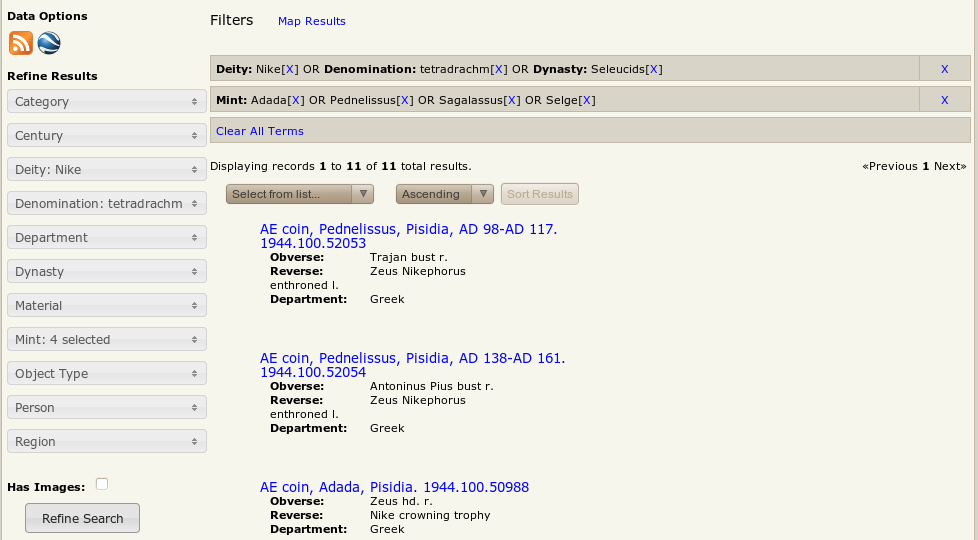
The new American Numismatic Society collection interface will enable users to navigate from records of coins to other objects related by various attributes (issuer, deity, material, etc.) via hypertext links, which redirect the user to the search results page for that particular query. This is one of the features that made the University of Virginia Art Museum Numismatic Collection such a versatile site when it went live in early 2008. Given our ability to map query results in OpenLayers with a Solr-to-KML transformer, we wanted to take the mapping up a notch by visualizing relationships geographically that had only been represented textually in other Numishare sites.

A small map is embedded in a jQuery tab. This map has several layers, each representing facets, that can be turned off and on as the user requires.


Each mint or cluster of mints on the map can be clicked to display a popup that displays the mint name(s) and available facets at that location. The list of facets is represented by a set of checkboxes, and a link within the popup opens a search results page with the selected facets at that mint. The task of displaying checkboxes within the popup is harder than it seems. OpenLayers does not support selecting multiple features on more than one layer at a time, so a handful of Solr queries must be executed upon clicking the feature.

  1. The mint names of the feature are gathered.
  2. For each visible layer, Solr is queried to see if there are any search results for that facet located at that mint (e.g., is there at least 1 result for Nike at Tyre, Sidon, or Berytus?)
  3. If so, return a checkbox via Ajax with some prepopulated value.
  4. When the user clicks on the "View" link, javascript is fired off to assemble the values of the checkboxes into a proper Solr query and opens the search results in a new browser window.

Using the map interface from the object page enables us to formulate far more complex queries than the linking approach does. Once the user arrives at the search results, he or she can easily adjust the query by adding/removing facets or sorting the results by a wide variety of fields. There are currently several alternate data delivery options offered through the linked icons on the top left of the screen: an Atom feed of the query (useful for scholars who may only want to subscribe to Roman Republican coins, for example) and a KML representation of the query that can be loaded by Google Earth. These are just some of many new features the new ANS collection interface will exhibit when it launches within the next few weeks.

Monday, February 28, 2011

The American Numismatic Society collection within time and space

The American Numismatic Society collection represents one of the largest numismatic datasets in existence. Such a large collection of digital objects lends itself to the potential for meaningful quantitative analysis, including the geographical distribution of coins based on a variety of physical and categorical attributes. Mapping coins over time and space is useful to scholars of economic history, art history, and many other disciplines for which coins are an important resource. For example, how have depictions of deities changed over time in mints of Syria? What do Flavian coins found in a late third century English hoard indicate about monetary circulation and the perceived value of centuries-old coins? What do issues depicting Concordia indicate about political conditions in the Roman Empire at that particular time? Dynamic visualization based on researchers' queries can lead to hypotheses that would have otherwise never been considered.

Currently, we are building a mapping interface for the ANS collection that utilizes a variety of free and open source tools: Apache Solr for the search index and OpenLayers for the display of maps. Ajax calls connect the two together to form a seamless interface. When coins are indexed into Solr, the script checks nomisma.org's authority list of mints to acquire the latitude and longitude of each's coins mint (when possible). OpenLayers then builds its point layer with a KML file generated dynamically from the Solr search results for user's query. A list of facets appears under the map, providing the user with the ability to filter results based on constraints like deity, material, denomination, issuer, and region.

OpenLayers enables the clustering of mints found within close proximity to each other, simplifying the interface when zoomed out. The popup bubble in the image displayed above contains the names of the mint or mints within the layer feature. The user can click on the "view" link to load the list of coins that meet the search criteria in the space below the map.


An issue from Tricca depicting Larissa, the nymph named for her city of origin. Unusual?

While the user is able to filter results by century, a future version of this application will feature a time slider for more precise temporal visualization. The functionality of the ANS mapping widget will grow considerably in the following months and will be available with the release of the new collection interface in mid-March.