Tuesday, January 25, 2022

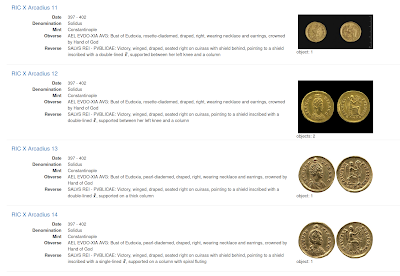
About 600 RIC X photographed gold coins from the British Museum added to OCRE

Before the holiday, I received a spreadsheet export from Richard Abdy, one of the curators in the Coins & Medals department at the British Museum, which includes all of the photographed gold coins from RIC volume X. This represents an addition of approximately 600 objects to Online Coins of the Roman Empire. Quite a few of these contributions represent the only photographed example of the type.

Gold coins from RIC 10 in OCRE.


Thursday, January 6, 2022

Swiss National Museum joins Nomisma

Under the direction of long-time Nomisma scientific committee member Christian Weiss, the Swiss National Museum has joined the Nomisma Linked Open Data cloud, providing data for nearly 8,500 coins in the collection to various online type portals, including Hellenistic, Roman Republican, Imperial, and British Iron Age coinage.

The most significant contribution comes in the form of 8,000 Swiss coins from the Medieval to Modern periods in the prototype Online Swiss Coin Archive (OSCAR) project, which catalogs more than 9,000 typologies produced in Switzerland from 491 CE to the present day. Already, several hundred coins from Berlin and Winterthur were accessible through OSCAR in previous data imports. While OSCAR is not yet complete (there is much work remaining in creating Nomisma URIs for Swiss authorities and denominations), the preliminary RDF data for OSCAR have been uploaded into the Nomisma SPARQL endpoint, facilitating more advanced visualization and context in associated Nomisma URIs (see Zurich, for example). With the Swiss National Collection online, more than 40% of the Swiss types in OSCAR are illustrated by at least one photographed specimen.


OSCAR 257, a 1533 schilling from Zurich

Monday, January 3, 2022

More than 8,000 Roman Imperial Coins from the BnF added to OCRE

More than 8,000 Roman Imperial coins from the Bibliothèque nationale de France have been integrated into Online Coins of the Roman Empire. This is a significant addition to the project, but does not represent the fully body of the BnF's material. The import includes the issues from Augustus to Trajan, a portion of the Hadrianic collection, and later coins from Carus to Diocletian.

This represents the BnF's first contribution to OCRE after providing large amounts of Roman Republican and Hellenistic coinage and a modest number of British Iron Age coinage to Iron Age Coins in Britain. Presently, the Bibliothèque nationale has made nearly 40,000 coins available in the numismatic Linked Open Data cloud.

A BnF coin (IMP-139) with IIIF images of type Hadrian II.3 510


Tuesday, November 30, 2021

Royal Library of Belgium joins Nomisma

The Royal Library of Belgium (KBR; Nomisma URI: http://nomisma.org/id/kbr) is the newest organization to join the Nomisma.org consortium, providing data for about 750 Roman Republican coins in its collection to Coinage of the Roman Republic Online. The Royal Library of Belgium is one of the largest numismatic collections in Europe, with more than 200,000 objects, and the first Belgian institution to make part of their collection available as Linked Open Data to Nomisma. We hope to integrate their Roman Imperial and Greek coins in other type projects eventually.


A KBR coin (Inv. II, 64.869) linked to RRC 250/1

There are now nearly 60,000 coins available in CRRO (connected to about 2,000 types), making it the most comprehensive resource of its type on the web.

Friday, October 22, 2021

Nomisma pages for organizations list members

I have made a small update to the Nomisma.org interface for corporate bodies that will display a list of member people and organizations (and their roles, and start/end date(s), when available). This has been on my agenda for awhile, and makes it easier to drill down from broader political entities, such as the Seleucid Empire, down into individual authorities and issuers, organized chronologically.


Kings and provinces of the Seleucid Empire.

I actually wrote this SPARQL query in the Nomisma framework perhaps a year ago, but never built the underlying pipelines to activate an API URL that executes the query and transforms it into HTML for the Nomisma UI. It only took me a couple of hours this morning to wrap this up. 

The list of entities can be downloaded as CSV. Coverage of the Greek world is quite good, owing to the work we've done to create people and organizations for the publication of the Inventory of Greek Coin Hoards in the Hellenistic Royal Coinages project.

We have an outstanding spreadsheet of Roman emperors to be re-ingested into Nomisma, linking them to dynasties and corporate entities. I hope that we will publish these updates soon.

Thursday, October 21, 2021

First Smithsonian medal added to Art of Devastation

I happened upon the Smithsonian American Art Museum collection database of medals earlier and came across a World War I medal that I thought might be in the American Numismatic Society's Art of Devastation project, and sure enough I was able to locate this French Heroes Fund medal from the Medallic Art Company (the archival materials and a large number of objects from which the ANS acquired at auction a few years ago and will catalog/publish online, by the way).

I was able to create a Nomisma URI for the SAAM and generate a bit of RDF for this medal, linking it to IIIF images hosted by the Smithsonian. There are almost certainly more WWI medals from the SAAM that we might later integrate into the Nomisma.org linked open data cloud.

SAAM 1965.16.63


Friday, September 24, 2021

More than 2,000 coins of Hadrian from the British Museum added to OCRE

I have received a major update from Richard Abdy, curator at the British Museum and author of the most recent RIC volume on Hadrian, which was published to OCRE in June of 2020. Nearly 2,300 coins from the British Museum have been linked to Hadrian type URIs in the new volume, an increase by about 2,000 over the relatively small number of Hadrianic coins the BM had previously contributed to OCRE. The photographic coverage of Hadrian types is nearly complete. There are, in fact, about 850 types where the British Museum specimen is the only photographed example: about one-quarter of all Hadrianic coin types.

Furthermore, I queried the BM's API for each coin to extract IIIF service URIs, when available. This extended to all of the BM's contributions to the Nomisma.org ecosystem (Iron Age, Hellenistic, and Roman coinage), and about 16,000 of the 72,000 total coins from the British Museum have zoomable IIIF images.


A British Museum example of Hadrian 103


The British Museum's API for individual objects is not publicized, but I happened upon it by looking at the console in Firefox to locate the British Museum's IIIF URI pattern (which is also not publicized). The ID portion of the object URI serves as the 'id' request parameter for the API, e.g., https://www.britishmuseum.org/api/_object?id=C_1872-0709-376.

The IIIF URL is 'zoom' property for each 'processed' in the 'multimedia' array. This is a relative path that should be appended to https://media.britishmuseum.org/iiif/. The other static jpg files paths are appended to https://media.britishmuseum.org/media/.

Frustratingly, the object metadata are not encoded in the JSON response as clean and machine-readable. It is possible to parse data from the escaped HTML in 'xtemplate', but it requires a little clean-up. I was able to parse the measurements for the Hadrianic coins from the xtemplate for the Hadrianic coins in OpenRefine, since they weren't in the the spreadsheet export I had received.